


Most used cars in the UK are now bought on finance rather than cash, yet many buyers sign an agreement without fully understanding what they've committed to. Covered below are the three main ways to finance a used car, what each genuinely costs, which one leaves you owning the car, whether bad credit rules you out, and the specific myths and mistakes that catch buyers out most often.
Overview:
- Hire Purchase (HP) guarantees you own the car outright at the end, with higher monthly payments and no mileage limits.
- PCP (Personal Contract Purchase) offers the lowest monthly payments but only leads to ownership if you pay a final lump sum called the balloon.
- A personal loan gives you outright ownership from day one since you're buying the car directly rather than financing it through the dealer.
- Bad credit doesn't rule out finance entirely, though rates run higher and options narrow.
- PCP being "always cheaper" is a genuine myth. It only saves money if you hand the car back at the end.
What Are the Main Ways to Finance a Used Car?

Three products cover almost every used car finance deal in the UK: Hire Purchase, Personal Contract Purchase and personal loans. Each works on a genuinely different structure, not just different branding for the same thing.
| Feature | Hire Purchase (HP) | PCP | Personal Loan |
|---|---|---|---|
| Monthly payments | Higher | Lower | Varies by term |
| Deposit needed | Usually required | Typically 10-20% | Often none |
| Own the car at the end | Yes, automatically | Only if you pay the balloon | Yes, from day one |
| Mileage limits | None | Yes, with excess charges | None |
| Ownership during the agreement | Lender owns it | Lender owns it | You own it |
| Typical used car APR | Around 7-9% | Around 7-10% | Around 6-10% |
How Does Hire Purchase (HP) Work?
How Payments Are Structured
You pay an initial deposit, then fixed monthly instalments that cover the full price of the car plus interest, spread across the agreed term, typically two to five years. Every payment brings you closer to full ownership, with no balloon payment lurking at the end.
Who Owns the Car During an HP Agreement?
The finance company technically owns the car until the final payment clears, even though you're the one driving it and responsible for insuring and maintaining it. You can't legally sell the car during this period without settling the finance first since you don't hold full title to it yet.
What Happens at the End of an HP Deal?
Once the final payment goes through, ownership transfers to you automatically, with no further action or extra payment required. There's no balloon, no mileage penalty and no decision to make. You simply own the car outright from that point on.
How Does Personal Contract Purchase (PCP) Work?
How Payments Are Structured
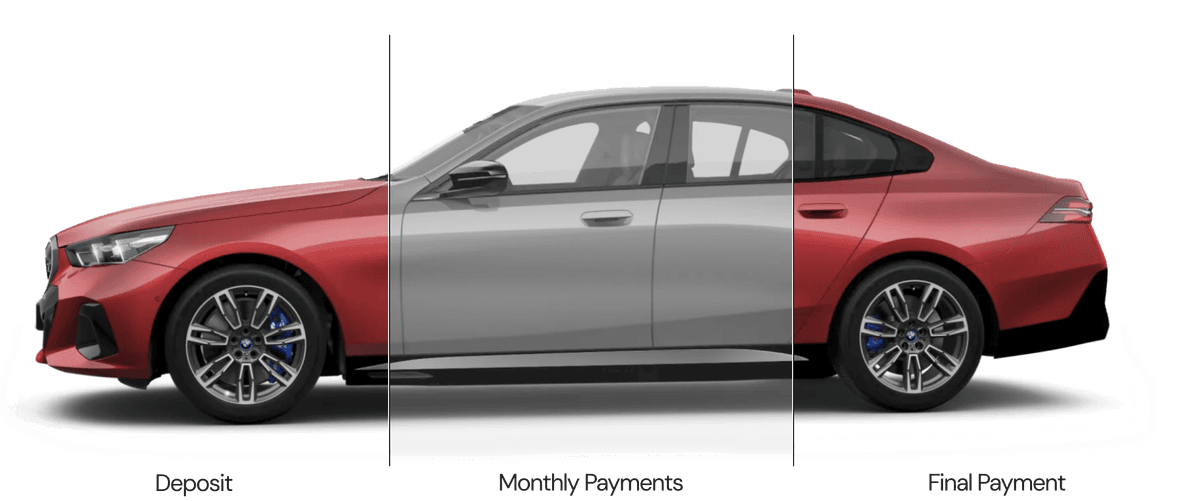
You pay a deposit, typically 10 to 20 percent of the car's price, then monthly payments covering only the car's predicted depreciation over the term rather than its full value, explaining why PCP monthly payments run noticeably lower than HP for the same car.
What Is the Guaranteed Minimum Future Value (GMFV)?
The GMFV, sometimes called the balloon payment, is a lump sum fixed at the start of the agreement, representing what the lender predicts the car will be worth at the end of the term. It's this figure, not the car's full price, that your monthly payments avoid covering directly.
Your Three Options at the End of a PCP Deal
You can hand the car back with nothing further to pay, provided it's within the agreed mileage and in acceptable condition under the industry fair wear and tear standard. You can pay the GMFV in full to keep the car outright. Or you can part-exchange it, using any equity above the GMFV as a deposit toward your next car. Industry data suggests only around 15 to 20 percent of PCP customers actually pay the balloon and keep their car, with most either handing it back or rolling into a new agreement.
How Does a Personal Loan Work for Buying a Car?
How Payments Are Structured
You borrow a fixed sum from a bank or lender, use it to buy the car outright, then repay the loan in fixed monthly instalments over one to seven years, entirely separate from the car itself. The car has no formal connection to the loan agreement in most cases.
Why You Own the Car Outright From Day One
Since you're buying the car with borrowed money rather than financing it through the dealer, you become the registered owner immediately, with no lender holding title in the background, giving you complete freedom to sell, modify or use the car however you like, without needing anyone's permission or having to settle anything first.
PCP vs HP vs Personal Loan: Which Is Cheapest?
Comparing Monthly Payments
PCP wins on headline monthly cost almost every time since you're only financing depreciation rather than the car's full value. HP payments run noticeably higher for an identical car. A personal loan's monthly cost depends heavily on the term you choose, often landing somewhere between the two.
Comparing Total Cost Over the Full Term
This is where the popular assumption that PCP is automatically cheapest falls apart. If you hand the car back at the end of a PCP deal, it often does work out cheapest overall. If you pay the balloon and keep the car though, PCP frequently costs more in total than HP would have since PCP interest rates are often slightly higher and you're paying interest across the whole car value, including the deferred balloon amount, for the full term. Always compare the total amount payable, not just the monthly figure, before deciding.
Which Option Suits Which Type of Buyer?
HP suits buyers who know they want to keep the car long term and value the simplicity of guaranteed ownership with no balloon or mileage limit hanging over them. PCP suits buyers who like changing cars every few years and are comfortable handing the car back rather than owning it outright. A personal loan suits buyers who want full ownership and flexibility from day one, particularly useful for older used cars that some dealer finance products won't cover.
What Deposit Do You Need for Each Option?
HP typically requires a deposit, though the exact amount varies by lender and your credit profile. PCP deposits usually sit between 10 and 20 percent of the car's price, directly affecting your monthly payment since a larger deposit reduces the amount you're financing. Personal loans often need no deposit at all since you're borrowing the full purchase price and buying the car separately.
What Credit Score Do You Need for Car Finance?
There's no single score that guarantees approval with any lender, nor a universal minimum threshold across the industry. Lenders look at your full financial situation, including income, existing credit commitments and overall affordability, not just one number in isolation.
Can You Get Car Finance With Bad Credit?
Yes, bad credit doesn't automatically rule out finance. Specialist bad credit lenders exist specifically for buyers who've been declined elsewhere, though rates run noticeably higher to reflect the increased risk the lender is taking on, often alongside vehicle restrictions such as maximum age or mileage limits on the car you're financing. The finance remains secured against the vehicle in most cases, meaning missed payments risk repossession as well as further damage to your credit file.
How a Soft Search Quote Works
Reputable lenders run a soft search first, giving you an indicative quote without leaving any mark on your credit file. A hard search, which does show up to other lenders, only happens once you decide to actually proceed with an application. Always confirm which type of check you're agreeing to before submitting any application, particularly when comparing multiple quotes.
Can You Settle Car Finance Early?
Early Settlement on HP and Personal Loans
Both allow early settlement, with the lender providing a settlement figure covering the remaining balance plus any applicable interest adjustment. Paying off early on these products is generally straightforward and predictable.
Early Settlement on PCP
PCP settlement works similarly, though the figure includes the outstanding balance toward the GMFV as well as the regular payments. One lesser-known right applies specifically here and to HP: voluntary termination. Under the Consumer Credit Act 1974, once you've paid 50 percent of the total amount payable, including the balloon on PCP, you can hand the car back and walk away with no further liability, provided it's in fair condition. Below that 50 percent threshold, you can still settle early. You'll owe the difference up to that point though.
Is There a Penalty for Paying Off Early?
Most agreements don't charge a specific penalty fee, though you may pay a small amount of extra interest depending on exactly when you settle within the term. Always request an official settlement figure directly from your lender rather than estimating it yourself since the exact amount depends on your specific agreement terms.
Pros and Cons of Hire Purchase
Advantages:
- You own the car automatically once the final payment clears, with nothing further to pay or decide.
- No mileage restrictions, meaning heavy annual driving never triggers an unexpected charge.
- A simpler structure overall, with no balloon payment or end-of-term decision to weigh up.
- Fixed monthly payments make budgeting straightforward across the full term.
Disadvantages:
- Higher monthly payments than PCP for the same car since you're financing the full price rather than just depreciation.
- You don't legally own the car during the agreement, limiting your ability to sell or modify it freely.
- Less flexibility at the end since there's no option to hand the car back if your circumstances change.
Pros and Cons of PCP

Advantages:
- Lower monthly payments since you're only financing the car's predicted depreciation.
- Genuine flexibility at the end, with the choice to hand back, pay the balloon or trade in.
- Access to a newer or higher-specification car than the same monthly budget would stretch to on HP.
Disadvantages:
- Mileage limits apply, with excess charges if you go over your agreed allowance.
- Fair wear and tear assessments at handback can result in unexpected charges for damage beyond normal use.
- Total cost can exceed HP if you pay the balloon and keep the car, despite the lower headline monthly figure.
- You never build equity automatically unless the car's real value ends up above the GMFV.
Pros and Cons of a Personal Loan
Advantages:
- You own the car outright immediately, with complete freedom to sell, modify or use it however you like.
- No mileage limits or condition assessments to worry about since the loan has no connection to the car's condition.
- Often the most straightforward product to compare since personal loans are widely available from banks and other lenders beyond just car dealerships.
Disadvantages:
- Usually requires a stronger credit profile for the most competitive rates since the loan typically isn't secured against the car itself.
- No deposit often means borrowing the full amount, which can mean a larger loan and correspondingly higher monthly payments.
- You carry the full depreciation risk yourself, unlike PCP where that risk sits with the lender via the GMFV.
Can You Get Car Finance on an Older or High-Mileage Used Car?
Yes, though options narrow as a car's age and mileage increase. Many mainstream lenders set maximum age or mileage limits, commonly excluding cars over 10 to 15 years old or with mileage well into six figures since the car itself often forms part of the security behind the loan. Specialist used car finance providers exist specifically for older vehicles that mainstream lenders won't touch, though rates typically run higher to reflect the increased risk of financing a car with a shorter remaining lifespan. A personal loan sidesteps this issue somewhat since the lender's decision rests on your creditworthiness rather than the specific car you're planning to buy.
What Documents Do You Need to Apply for Car Finance?
Most lenders ask for proof of identity, such as a passport or driving licence, alongside proof of address, typically a recent utility bill or bank statement. You'll also need to confirm your income, usually through recent payslips or bank statements showing regular earnings, plus provide details of your employment status. Self-employed applicants often need to show additional evidence, such as tax returns or an accountant's reference since irregular income can be harder for a lender to assess quickly.
Having these documents ready before you apply speeds up the process considerably, particularly useful if you're trying to secure finance quickly to avoid losing a specific car to another buyer.
Should You Get GAP Insurance With Car Finance?
Guaranteed Asset Protection, or GAP insurance, covers the difference between what your car insurer pays out if the car is written off or stolen and what you still owe on your finance agreement, a gap that can be genuinely significant on a PCP or HP agreement, particularly in the early years when depreciation outpaces how much you've paid off.
It's worth considering seriously if you've put down a small deposit or chosen a longer finance term, both of which widen the potential gap between the car's insurable value and your outstanding balance. It's less essential on a personal loan where you own the car outright, though the same depreciation risk still applies to your own investment in the car even without a separate finance company involved.
What Happens If You Want to Sell the Car Before Finance Ends?
You can't legally sell a car you don't yet fully own, which is exactly the position you're in throughout an HP or PCP agreement. Settling the outstanding finance first is required before ownership, and with it the legal right to sell, transfers to you. In practice, this usually means either paying off the remaining balance yourself or arranging for a dealer to settle it directly out of the sale proceeds when you trade the car in.
This is one of the genuine practical differences worth understanding before choosing a car through a private seller versus a dealer, particularly since a private seller may still have finance outstanding on the car they're selling you. Our guide on independent dealer versus private seller covers this distinction in more detail.
What Are the Biggest Myths About Car Finance?
"PCP is always the cheapest option." False. PCP only saves money if you hand the car back at the end. Keep it by paying the balloon though and you'll often pay more in total than HP would have cost for the same car.
"A good credit score guarantees the advertised rate." Not necessarily. Advertised APRs are usually "representative," meaning only a portion of successful applicants, often just 51 percent, actually receive that exact rate. Your personal quote can land considerably higher.
"You automatically own the car once you've made your deposit." No. With both HP and PCP, the finance company retains legal ownership until the final payment, or balloon, clears in full.
"Voluntary termination isn't a real option." It genuinely is. It's a right built into the Consumer Credit Act 1974 though, one very few buyers who qualify for it ever actually use.
"Paying a bigger deposit always saves you money overall." Not automatically. A larger deposit does reduce your monthly payments and the total interest charged, tying up more of your own cash upfront though. Whether that trade-off makes sense depends on what else that money could otherwise be doing for you, not just on the finance figures alone.
What Mistakes Do Buyers Commonly Make With Car Finance?
Focusing Only on the Monthly Payment
A low monthly figure can hide a genuinely expensive deal once the full term and any balloon payment are added up. Always ask for the total amount payable across the whole agreement before comparing offers.
Not Checking the Total Cost of Credit (APR vs Total Payable)
APR gives you a standardised way to compare rates between lenders. The total cost of credit, the actual pounds and pence of interest you'll pay, matters just as much though. Two deals with similar APRs can still cost noticeably different amounts depending on the term length and deposit.
Underestimating Mileage Limits on PCP
Excess mileage charges on PCP typically run between 6p and 30p per mile over your agreed limit, adding up fast if your circumstances change partway through the agreement. Choose a realistic mileage allowance from the outset rather than accepting a lower figure purely to shrink the monthly payment.
Not Reading the Early Settlement Terms
Buyers frequently discover the true cost of exiting an agreement early only once they need to, rather than checking beforehand. Understanding your settlement figure and your voluntary termination rights before signing avoids an unpleasant surprise later.
Has Car Finance Mis-Selling Affected UK Buyers?
Yes. It's worth knowing about even if you're financing a car now rather than looking back at an old agreement. The Financial Conduct Authority has confirmed a redress scheme covering motor finance agreements taken out between April 2007 and November 2024, following findings that some lenders failed to properly disclose commission arrangements to customers.
Two specific practices are at the centre of this: discretionary commission arrangements, where a broker could adjust your interest rate to earn a higher commission, and high commission arrangements, where the commission exceeded set thresholds relative to your total cost of credit. The scheme is expected to return several billion pounds to affected customers, with an average payout in the hundreds of pounds per eligible agreement, though the scheme has faced legal challenges and parts of it remain under review.
If you financed a car during this period, your lender should contact you directly if you're eligible. You shouldn't need to pay anyone to access compensation you're owed. Be cautious of unsolicited contact asking for a fee or personal banking details in relation to this scheme since scams have followed in its wake.
This history is also part of why commission transparency has become a bigger focus industry wide. Dealers and brokers are now expected to be considerably clearer about how they're paid for arranging finance. Asking directly how a specific deal is being remunerated remains a completely reasonable question to put to any dealer or broker before signing.
When Is the Best Time to Finance a Used Car?
Timing matters less than preparation for most buyers. A few factors genuinely help though. Applying when your existing credit commitments are lower, rather than immediately after taking on other debt, generally improves the rate you're offered. Shopping quotes across several lenders using soft searches, rather than applying to just one, lets you compare real personalised rates rather than headline advertising figures.
Avoiding a rushed decision at the dealership itself matters too. Arranging a quote or even a decision in principle before you visit, through an independent broker or comparison site, gives you a genuine benchmark to compare against whatever the dealer offers on the day.
Should You Get Finance Through a Dealer, a Broker or Your Bank?
Dealer finance offers convenience since you can arrange everything at the point of purchase, though the rate on offer isn't always the most competitive available to you personally. Independent brokers search across a panel of lenders on your behalf, often turning up rates a single dealer wouldn't offer, particularly useful if your credit profile is slightly outside the mainstream. Your own bank or building society is worth checking too, especially if you already hold accounts with them since an existing relationship can sometimes translate into a preferential rate.
Getting a quote from at least two of these three routes before committing gives you a genuine benchmark, rather than accepting the first figure you're offered simply because it's convenient.
What Happens If Your Car Finance Application Is Declined?
A decline doesn't necessarily reflect your overall creditworthiness since different lenders use different criteria and risk appetites. Requesting the specific reason from the lender, where they're required to provide one, helps you understand whether the issue is fixable, such as a specific missed payment showing on your file, or more structural, such as limited credit history overall.
Applying again immediately with a different lender rarely helps and can create multiple hard search entries on your file in a short period, which itself can look unfavourable to future lenders. Waiting a short period, addressing any specific issue identified and trying a lender genuinely suited to your credit profile tends to produce a better outcome than repeatedly reapplying.
Frequently Asked Questions
Is PCP or HP better for a used car? It depends entirely on whether you plan to keep the car long term. HP suits buyers wanting guaranteed ownership with simpler terms, while PCP suits buyers who prefer lower monthly payments and don't mind handing the car back every few years.
Can I part-exchange a car still on finance? Yes, in most cases. The dealer settles your outstanding finance directly using the trade-in value. Any amount above the settlement figure counts toward your next car's deposit.
What happens if I can't keep up with payments? Contact your lender immediately since many offer temporary arrangements before things escalate. Missed payments can lead to repossession on secured agreements and will damage your credit file regardless of the finance type.
Does car finance affect my credit score? Yes, both positively and negatively. Consistent on-time payments build a positive credit history, while missed payments or a high level of existing credit can lower your score and affect future applications.
Can I get car finance as a first-time buyer? Yes, though limited credit history can mean higher rates or a request for a larger deposit since lenders have less data to assess your reliability with.
Should I finance through the dealer selling me the car? Not necessarily. It's convenient. Comparing at least one independent quote first though, whether through a broker or your own bank, often reveals a better rate than accepting the dealer's offer by default.
Does the type of car I'm buying affect which finance suits me best? Yes, to an extent. Older or higher-mileage cars sometimes fall outside mainstream PCP or HP lending criteria, making a personal loan or a specialist used car finance product more realistic in those cases.
Conclusion
None of the three finance options is objectively best. Each one trades cost, ownership and flexibility differently. The right choice comes down to how long you plan to keep the car and how much certainty you want built into the deal from day one. HP suits buyers who value guaranteed ownership and a simple structure. PCP suits buyers who prioritise a lower monthly payment and don't mind handing the car back every few years. A personal loan suits buyers who want full control and ownership from the outset, particularly on older cars that mainstream dealer finance won't touch.
What matters most across all three is looking past the headline monthly figure. The total amount payable, the settlement terms, the mileage limits and the genuine reason a rate is being offered all shape whether a deal is actually good value, not just affordable on paper. Buyers who compare properly, ask direct questions about commission and read the fine print before signing consistently end up with a fairer deal than those who accept the first offer at the dealership.
Every car sold through Car Planet comes with finance options clearly explained before you commit to anything. You can compare HP, PCP and personal loan costs honestly against each other, rather than being steered toward whichever pays the highest commission.