


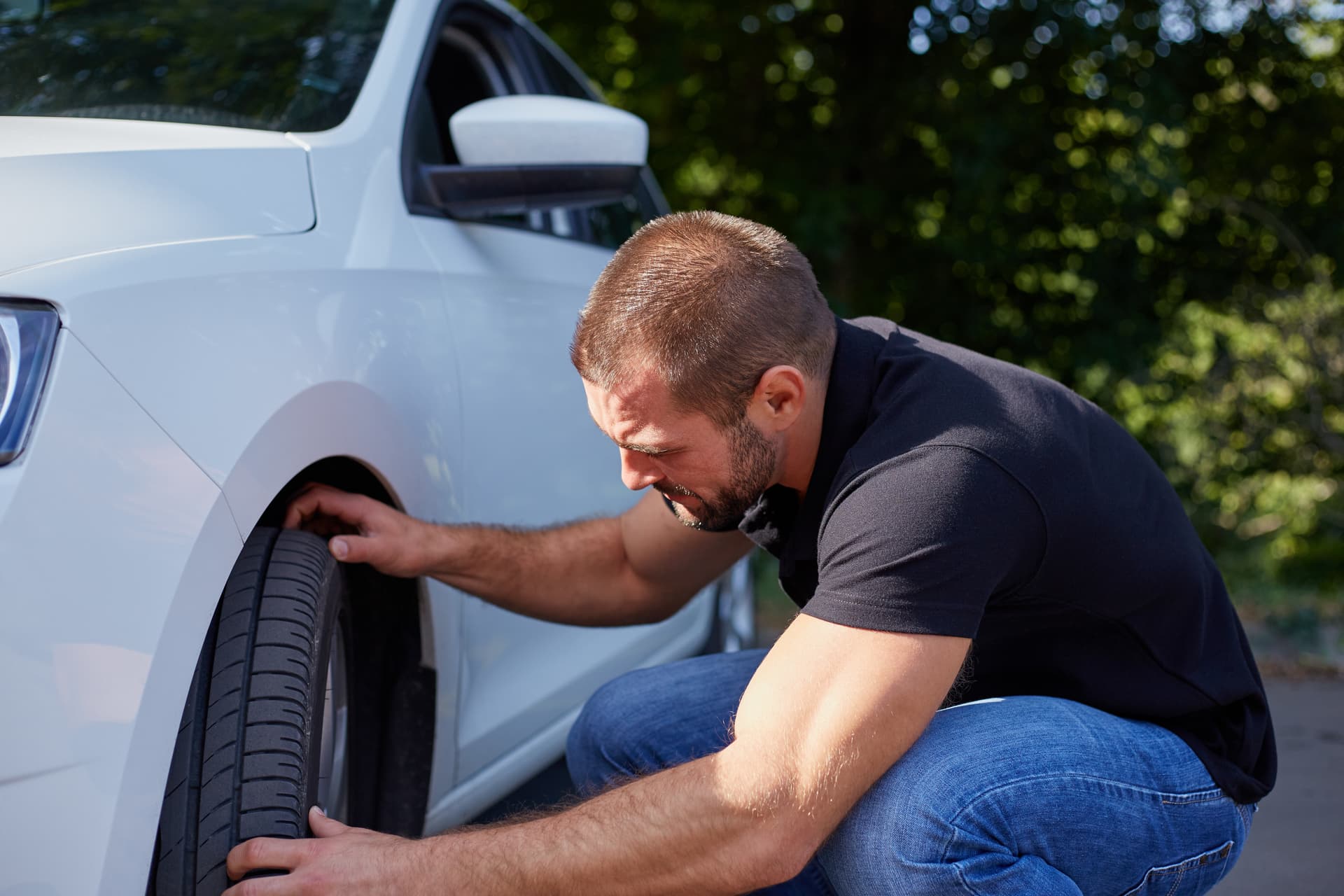
Checking a tyre takes about thirty seconds and costs you nothing but a 20p coin. Most drivers still get it wrong, because they check one spot on one tyre and call it done.
That's the part worth fixing. A tyre can pass the coin test where you're crouched and fail the law six inches further round the wheel, and it's the failing bit that decides whether you stop in time, whether you pass your MOT, and whether you're carrying points you didn't know about.
Summary:
- The legal minimum is 1.6mm, measured across the central three-quarters of the tread, in a continuous band all the way round the tyre.
- The 20p test is a screening check, not a measurement. It tells you pass or fail. A £5 gauge tells you how much life is left.
- Check at least three points around each tyre and across its width, inner, centre and outer. Uneven wear is the norm, not the exception.
- Replace at 3mm, not 1.6mm. MIRA's wet braking tests found stopping distances rise sharply below 3mm.
- Penalties are per tyre. Up to £2,500 and 3 points each, so four bad tyres is £10,000 and an automatic ban.
What the Law Actually Says
The requirement comes from Regulation 27 of the Road Vehicles (Construction and Use) Regulations 1986. For cars, vans and trailers up to 3,500kg, the main tread grooves must be at least 1.6mm deep across the central three-quarters of the tread width, in a continuous band around the entire circumference.
Two details in that sentence catch people out.
"Central three-quarters" means the outer edges aren't measured. But the shoulders are usually where wear shows up first, so a worn edge is your early warning even though it isn't the legal test.
"Continuous band" means the tyre has to be legal everywhere, not on average. One worn strip makes the whole tyre illegal, regardless of how deep the rest of it is.
The limits vary by vehicle type:
- Cars, vans, 4x4s, caravans and trailers up to 3,500kg: 1.6mm across the central three-quarters, full circumference.
- Motorcycles over 50cc: 1mm across the central three-quarters, with visible tread on the remainder.
- Mopeds and bikes 50cc and under: no set depth, but the original tread pattern must still be clearly visible.
- HGVs, buses and coaches: 1mm across the central three-quarters, full circumference.
One more thing worth knowing: only primary grooves count. Many tyres have shallower decorative or secondary grooves moulded in by design. You can tell the primary ones apart because they're the grooves containing the tread wear indicator bars.
How to Do the 20p Test Properly
- Park on level ground and, if you're checking the fronts, turn the steering to full lock. This swings the inner shoulder into view, the single most commonly missed part of a tyre.
- Insert a 20p coin into a main groove, pushing it in as far as it goes.
- Look at the raised outer band around the coin's edge. If it disappears completely into the groove, that spot is above the legal minimum. If any of it is still showing, that spot is at or below 1.6mm and needs a proper measurement.
- Repeat across the width: inner groove, centre, outer groove.
- Roll the car forward a metre or so and repeat. Do this at three or four points around the circumference.
- Do all five tyres. Your spare has to be legal too, and full-size spares are the ones people forget for a decade.
The coin works because its outer band sits close to the legal threshold. What it can't do is tell you how much tread you have. A tyre at 2mm and a tyre at 6mm both pass identically, and one of those is three months from being illegal. That's the case for spending £5 on a gauge.
Using a Tread Depth Gauge
A tread depth gauge is a small metal or plastic probe you push into the groove until the shoulder sits flat on the tread block. Digital ones read to a tenth of a millimetre; the pin-and-scale type cost a couple of pounds and are accurate enough.
The value isn't the precision itself, it's the trend. Note the readings down once a season and you can see how fast each tyre is wearing, which tells you when to budget for replacements and flags a tyre wearing faster than the others, usually the first sign of an alignment or pressure problem.
Finding the Tread Wear Indicators
Every modern tyre has small raised bars moulded into the base of the primary grooves, sitting at exactly 1.6mm. When the surrounding tread wears down flush with those bars, the tyre has hit the legal limit.
To find them, look on the sidewall for a small triangle, the letters TWI, or the manufacturer's logo, usually spaced at several points around the tyre. Follow that marker inward and you'll find the bar in the groove alongside it.
This is the most reliable no-tools check there is. It's built into the tyre by the people who made it, and it doesn't depend on you owning the right coin.
Legal Isn't the Same as Safe
MIRA ran wet-braking tests on four different vehicles at 50mph in 0.5mm to 1.5mm of standing water. At 3mm of tread, average stopping distance was 31.7 metres. At 1.6mm, it was 39.5 metres.
That's an extra eight metres, roughly two car lengths, arriving at the point where you'd already have stopped on 3mm tyres. The RAC cites differences in wet braking distance of up to 44% between the two depths depending on surface. Below 3mm, aquaplaning resistance drops off too, because there's simply less groove volume to shift water out from under the contact patch.
This is why the RAC, TyreSafe and RoSPA all recommend replacing at around 3mm rather than running to the legal floor.
For balance, there is a counter-argument. Michelin has publicly opposed raising the legal minimum, arguing that a well-designed tyre performs adequately down to 1.6mm and that replacing early costs drivers money and generates avoidable waste. The point has merit for premium tyres in good condition. But it depends on the tyre being a good one, evenly worn and correctly inflated, and on you never meeting standing water at speed. If you'd rather not bet on all three, 3mm is the sensible line.
Treat 3mm as the point you start shopping. Treat 1.6mm as the point you should already have replaced.
What Your Wear Pattern Is Telling You
Uneven wear is worth reading, not just measuring. The pattern points at the cause:
- Both shoulders worn, centre fine: under-inflation.
- Centre worn, shoulders fine: over-inflation.
- One edge only, usually the inner: wheel alignment, camber or toe.
- Patchy, scalloped or cupped: worn dampers or suspension bushes.
- Feathered edges on the tread blocks: toe misalignment.
Fixing the cause matters as much as fitting the tyre. A four-wheel alignment costs less than one tyre, and skipping it means the new one wears out the same way.
What Happens If You're Caught With Illegal Tyres?
Each illegal tyre carries a fine of up to £2,500 and 3 penalty points. Per tyre, not per vehicle.
A car with all four below the limit is therefore exposed to £10,000 and 12 points, and 12 points inside three years triggers a totting-up ban of at least six months. This is the detail that surprises people: a single roadside stop can end your licence.
Police and DVSA officers can also issue a prohibition notice on the spot, which stops the car being driven anywhere except to have the tyres replaced.
And an illegal tyre is a dangerous defect at MOT, an outright failure with no advisory, regardless of how the rest of the car performs.
Does This Affect Your Car Insurance?
Insurers can and do argue that illegal tyres contributed to a collision. In practice that can mean a reduced payout, a repudiated claim, or being held personally liable for third-party damage, which is uncapped.
A current MOT certificate doesn't protect you here. It records the car's condition on the day of the test, and tyres can go from legal to illegal in a few thousand miles.
Tyre Age Matters Separately
Rubber hardens and micro-cracks with age whether the car is driven or not. A low-mileage car can have tyres with 6mm of tread and the grip of a plastic bag.
Every tyre carries a DOT code on the sidewall ending in four digits. The first two are the week of manufacture, the last two the year, so 3624 means week 36 of 2024. Some tyres only show the full code on the inner sidewall, so you may need to look from underneath or turn the wheels to full lock.
Most manufacturers suggest inspecting anything over five years old annually and replacing at around ten, regardless of tread. If the sidewalls show fine cracking, replace them sooner.
While you're down there, check for cuts, bulges and lumps. A bulge means the internal structure has failed and the tyre can let go without warning. That one's a same-day replacement, not a "next service" job.
How Often Should You Check?
Monthly, plus before any long trip. TyreSafe recommends the same interval, and it pairs naturally with a pressure check.
Check pressures when the tyres are cold, because after a few miles the air inside has warmed and expanded and you'll get a falsely high reading. Tread depth itself doesn't change with temperature, so you can measure that whenever. Correct pressures are in the driver's door shut, inside the fuel filler flap, or in the handbook, and there are usually two sets: normal and fully laden.
Frequently Asked Questions
Is 2mm of tread legal?
Yes. Anything at or above 1.6mm across the measured area is legal. It's also close enough to the limit that you should be planning replacements.
Does the fine apply per tyre or per car?
Per tyre. Each illegal tyre carries its own fine and its own 3 penalty points.
Does my spare tyre need to be legal?
Yes, if you drive on it. It's assessed like any other tyre. Space-saver spares have their own speed and distance limits printed on the sidewall.
How long does a tyre last?
Most road tyres start at 7mm to 8mm and last 20,000 to 40,000 miles, but driving style, alignment and pressures move that enormously. Measuring twice a year tells you far more than any average.
Can I check tyre tread without a 20p coin?
Yes. Use the tread wear indicator bars in the primary grooves, or a tread depth gauge. The coin is a convenience, not a requirement.
Do illegal tyres cause an automatic MOT failure?
Yes, as a dangerous defect. So do cuts reaching the ply or cord, bulges, exposed cords, and tyres of the wrong size or load rating.
Is the 20p test accurate for motorcycles?
No. Bike limits are different at 1mm, and the coin is calibrated to the car limit. Use a gauge or the tyre's wear indicators.
Conclusion
The check itself is trivial. Doing it properly is what separates a useful thirty seconds from a false sense of security: several points around each tyre, across the full width, inner shoulder included, all five tyres.
Do that monthly and tread depth stops being something you find out about at the MOT. Replace at 3mm rather than 1.6mm and you buy back eight metres of wet stopping distance for the price of running your tyres slightly less far into the ground, which is, on any reasonable reading, a bargain.
Every car sold through Car Planet is inspected before it's listed, tyre tread and condition included. You're not inheriting a set that's three months from failing.