


Introduction
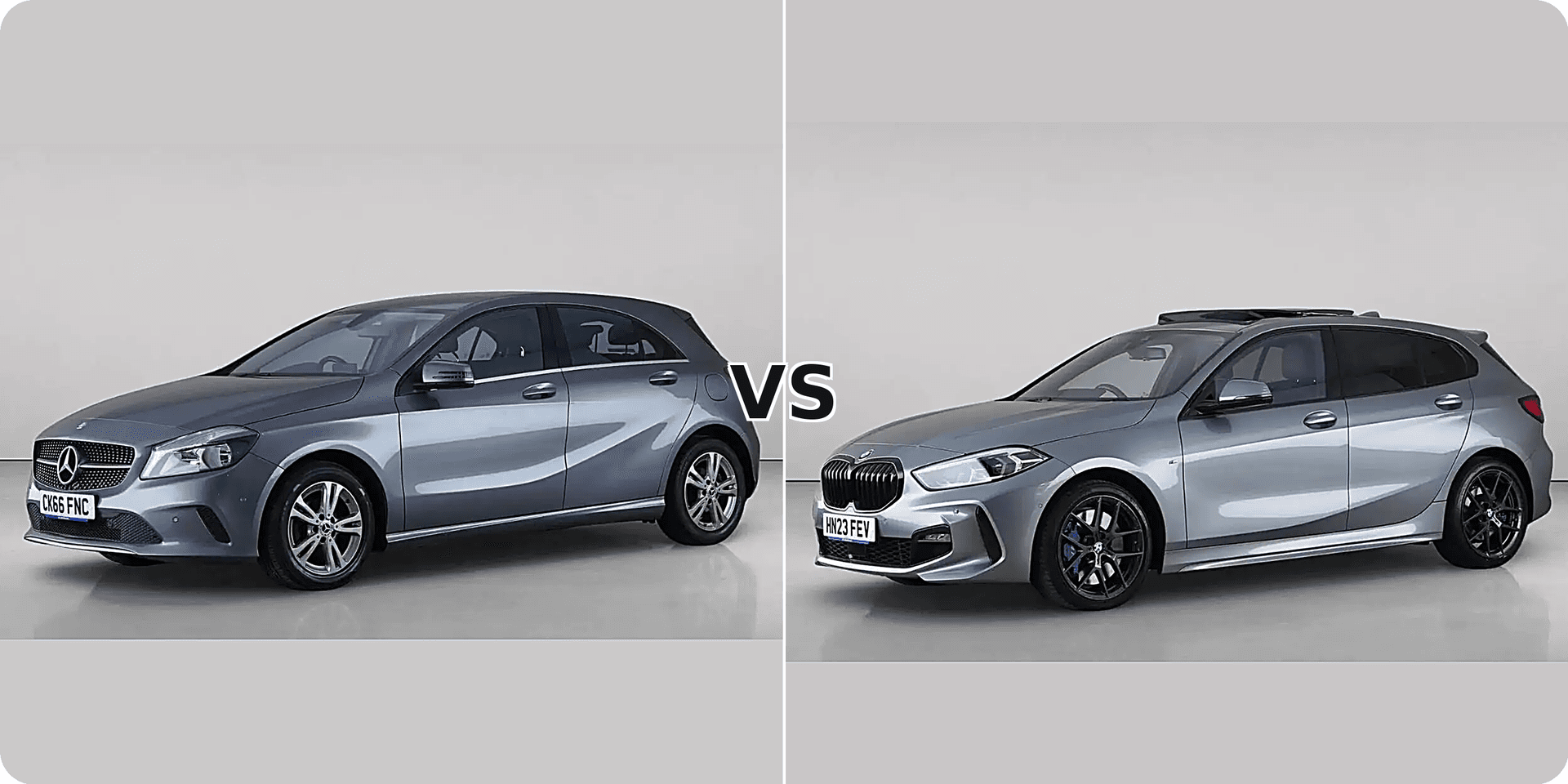
These two genuinely are direct rivals, unlike some premium hatchback match-ups, both sitting in the same size class and price bracket. The real differences come down to driving character, gearbox behaviour, and one boot space nuance most comparisons gloss over. Here's an honest breakdown covering practicality, performance, running costs, and which buyer each one genuinely suits.
Summary:
- Boot space is closer than the headline figures suggest. The 1 Series' mild-hybrid trims drop to around 300 litres, and a real-world luggage test found the Mercedes swallows an extra carry-on suitcase over the BMW.
- The gearboxes behave differently in everyday traffic. BMW's torque-converter automatic is smoother at low speed than Mercedes' dual-clutch, which can feel jerky, particularly on earlier cars.
- The BMW is the more engaging car to drive. The Mercedes prioritises comfort and a calmer ride instead.
- Mercedes' reliability reputation has genuinely improved on facelifted 2022-23 A-Class models specifically, worth knowing if you're comparing different ages of used car.
- BMW's standard warranty is longer, three years with unlimited mileage, extendable to 100,000 miles.
Styling, Dimensions and Practicality
Both cars follow their respective brand's current design language rather than looking like scaled-down versions of a larger model. The current 1 Series carries a genuinely bold, deep front grille alongside a restructured interior featuring vertical and diagonal trim details around the dashboard, a noticeably different look to the outgoing generation.
The A-Class presents a smart, smoothly sculpted exterior that most reviewers describe as distinctly premium for the size, without leaning as hard into aggressive detailing as the BMW.
The actual dimensions hold a genuine surprise. The current A-Class measures 4,428mm long, slightly longer than the 1 Series at 4,361mm, despite the 1 Series often being assumed the bigger car given its reputation.
Width sits close between the two, 1,800mm for the BMW against 1,796mm for the Mercedes, with height also similar at 1,459mm and roughly 1,423mm respectively. In short, these two are genuinely closer in footprint than the badges and reputations might suggest.
BMW's headline 380 litre boot figure only applies to the M135 hot hatch, which lacks the mild-hybrid battery fitted to the far more common 120 and 123 xDrive models. Those drop to just 300 litres, since the battery sits under the boot floor.
A genuine real-world test settles the question better than spec sheets alone. One independent used-car comparison physically loaded both boots with carry-on suitcases, fitting six into the Mercedes against just five in the BMW.
The BMW does claw back some practical points elsewhere though, with a lower loading lip and considerably more underfloor storage that clips open on its own, rather than needing to be propped up while you load and unload.
Rear seat flexibility differs too. The Mercedes splits 40/20/40 for folding, letting you carry longer items down the middle while still seating two rear passengers either side. The BMW's simpler 60/40 split is less flexible for exactly that scenario.
| Styling, Dimensions and Practicality | BMW 1 Series | Mercedes A-Class |
|---|---|---|
| Length | 4,361mm | 4,428mm |
| Width | 1,800mm | 1,796mm |
| Height | 1,459mm | Around 1,423mm |
| Boot space (mild-hybrid/standard trim) | 300 litres | 355 to 370 litres |
| Boot space (M135/hot hatch trim) | 380 litres | N/A |
| Real-world suitcase test | 5 carry-on cases | 6 carry-on cases |
| Rear seat fold | 60/40 split | 40/20/40 split |
| Underfloor storage | More generous, self-clipping | Standard |
| Loading lip | Lower | Higher |
Engines and Performance
Beyond the everyday trims, both brands offer a genuine hot hatch version worth knowing about if outright pace matters to you. BMW's range tops out with the front-wheel-drive 128ti at 265hp and the four-wheel-drive M135i at 306hp. Mercedes counters with the AMG A35, matching the M135i's 306hp, and the considerably more potent AMG A45, reaching 421hp.
For most everyday buyers though, the standard petrol and diesel engines matter more than these flagship variants. Mercedes' engines have been noted as slightly more responsive with broader power delivery in daily driving, though generally a touch noisier than BMW's equivalents, which stay notably hushed except under harder acceleration.
| Performance | BMW 1 Series | Mercedes A-Class |
|---|---|---|
| Fastest standard hot hatch | M135i, 306hp | AMG A35, 306hp |
| Range-topping performance model | M135i, 306hp | AMG A45, 421hp |
| Everyday engine character | Quieter, hushed except hard acceleration | Slightly more responsive, marginally noisier |
| Entry performance option | 128ti, 265hp, front-wheel drive | N/A at equivalent price point |
What Are They Like to Drive?
Beyond the gearbox, the two cars take genuinely different approaches to how they handle a road. The 1 Series comes with a sportier suspension setup and quicker, more responsive steering, staying true to BMW's driver-focused reputation even after the switch to front-wheel drive.
The A-Class prioritises ride comfort instead, with suspension tuned specifically to absorb road imperfections, trading outright agility for a smoother, more relaxed experience over rough surfaces.
The gearboxes reinforce this same character split. BMW's torque-converter automatic delivers power smoothly at low speed, making stop-start traffic feel relaxed and predictable. Mercedes uses a 7-speed dual-clutch transmission instead, which can feel noticeably jerky in slow-moving traffic, particularly on earlier W177 examples before running improvements were introduced.
If most of your driving happens in town, it's worth test driving both back to back specifically in traffic rather than judging purely from a spec sheet or a motorway test drive.
| What They're Like to Drive | BMW 1 Series | Mercedes A-Class |
|---|---|---|
| Steering | Quicker, more direct | More relaxed |
| Suspension focus | Sportier, agile | Comfort-tuned, absorbs bumps |
| Gearbox type | Torque-converter automatic | 7-speed dual-clutch |
| Low-speed traffic behaviour | Smooth, predictable | Can feel jerky, especially pre-facelift |
| Overall driving character | More engaging, firmer | Calmer, more comfort-focused |
| Steering | Quicker, more direct | More relaxed |
Interior and Technology
Both cabins reflect their brand's wider range rather than feeling like a scaled-down entry-level effort. The A-Class shares its components directly with larger Mercedes models, and its screen setup has evolved by generation, earlier cars use a tablet-style display mounted high on the dashboard, while later examples get a wider, more integrated widescreen display extending in front of the driver.
BMW takes a cleaner, more minimalist approach throughout, a look the brand has refined for decades. Newer examples of the current generation get a more stylish dashboard layout with updated gauges and screens, while older cars carry a more traditional look by comparison.
Both offer strong smartphone connectivity via Apple CarPlay and Android Auto, making it easy to hook into either car's system without relying purely on the built-in infotainment alone.
| Interior and Technology | BMW 1 Series | Mercedes A-Class |
|---|---|---|
| Dashboard style | Minimalist, brand-consistent | Shares components with larger Mercedes models |
| Infotainment | iDrive | MBUX |
| Screen evolution | More stylish on current generation | Tablet-style (early) to widescreen (later) |
| Smartphone connectivity | Apple CarPlay, Android Auto | Apple CarPlay, Android Auto |
Safety and Reliability
Both cars carry a genuinely comprehensive suite of safety technology as standard on most trims, including autonomous emergency braking and automatic headlights, and both have achieved a full five-star Euro NCAP crash rating, giving no clear advantage to either on outright safety.
Reliability tells a more interesting story though, and genuinely yes, Mercedes' reputation has improved. Earlier A-Class models, particularly around the MBUX infotainment system and the dual-clutch gearbox, drew real criticism for reliability teething problems.
Facelifted 2022-23 examples with updated software are widely reported as considerably more sorted, worth specifically seeking out if reliability concerns you and you're choosing between an earlier and later used A-Class.
The BMW's equivalent watch points sit elsewhere: the timing chain on the older 1.6-litre N13 petrol engine on pre-2017 cars specifically, the Valvetronic eccentric shaft sensor on the 2.0-litre B48 engine, and occasional iDrive electrical niggles on early examples of the current generation.
Both cars are generally well regarded for reliability when bought with a genuine, documented service history. For guidance on verifying this properly before buying either car, see our guide on car service history explained.
| Safety and Reliability | BMW 1 Series | Mercedes A-Class |
|---|---|---|
| Euro NCAP rating | Five stars | Five stars |
| Standard safety tech | AEB, automatic headlights | AEB, automatic headlights |
| Key reliability concern | N13 timing chain (pre-2017), B48 Valvetronic sensor | MBUX bugs, dual-clutch behaviour |
| Improved on | Current generation, later examples | Facelifted 2022-23 models specifically |
| General reputation | Generally well regarded with service history | Genuinely improved on newer facelifted cars |
Running Costs and Insurance
Road tax comes out identical between the two, both costing £165 a year on comparable versions. Insurance sits close too, one direct three-year-old comparison placing the 1 Series in group 23, working out to an average premium of around £661, broadly in line with an equivalent A-Class.
Individual quotes vary considerably by trim and driver profile though. Always get a genuine quote for the specific car you're considering rather than relying on a single reference figure.
Used values track closely as well. The same comparison found a three-year-old 1 Series priced around £21,000 against roughly £20,000 for an equivalent A-Class, a gap likely to persist as both cars continue depreciating at a similar rate.
One genuine differentiator worth knowing beyond day-to-day costs: BMW's standard warranty runs three years with unlimited mileage, extendable to 100,000 miles afterward, longer than Mercedes typically offers as standard.
| Running Costs | BMW 1 Series | Mercedes A-Class |
|---|---|---|
| Road tax | £165 a year | £165 a year |
| Insurance group (example) | Group 23 | Broadly comparable |
| Average premium (example) | Around £661 | Broadly comparable |
| Three-year-old used price (example) | Around £21,000 | Around £20,000 |
| Standard warranty | 3 years, unlimited mileage, extendable to 100,000 miles | Typically shorter |
Which One Actually Suits You?
The 1 Series makes sense if driving engagement genuinely matters to you, and you're comfortable with a smaller boot on the mild-hybrid trims specifically in exchange for a car that still feels properly involving to drive, suiting anyone wanting the longer standard warranty for extra peace of mind too.
The A-Class suits a buyer prioritising interior ambience, technology, and genuine practicality, since the MBUX system remains class-leading and the real-world luggage test result favours it too, alongside a calmer, more comfort-focused ride.
If most of your driving happens in slow urban traffic specifically though, the smoother torque-converter automatic on the BMW is worth weighing against the Mercedes' occasionally jerky dual-clutch, particularly on pre-facelift examples. Anyone wanting genuine hot hatch pace should look closely at the AMG A45 specifically, since it comfortably outguns anything BMW currently offers in this class.
Frequently Asked Questions
Which has the bigger boot in practice, the 1 Series or the A-Class?
A real-world luggage test found the Mercedes fits six carry-on suitcases against five in the BMW, despite BMW's higher headline litre figure on paper.
Is the Mercedes A-Class reliable?
Increasingly yes on facelifted 2022-23 examples specifically, following genuine improvements to the MBUX software and gearbox behaviour that drew criticism on earlier cars.
Which is cheaper to insure, the BMW or the Mercedes?
Broadly comparable at equivalent trims, with one direct comparison placing a three-year-old 1 Series in insurance group 23 at around £661 a year, similar to an equivalent A-Class.
Does the BMW 1 Series come with a longer warranty than the A-Class?
Yes, BMW's standard three year, unlimited mileage warranty is extendable to 100,000 miles, typically longer than Mercedes offers as standard.
Which has the faster hot hatch version, the 1 Series or the A-Class?
The Mercedes-AMG A45, at 421hp, comfortably outguns BMW's fastest 1 Series, the 306hp M135i, though the M135i is closely matched by the smaller AMG A35 at the same power output.
Conclusion
Neither car wins outright, and treating this as a straightforward contest misses what actually matters here. The BMW rewards a driver who genuinely cares about how a car feels through a corner and in slow traffic, backed by a longer standard warranty.
The Mercedes rewards a driver who cares more about cabin ambience, genuine day-to-day practicality, and a calmer overall experience, provided you seek out a facelifted example if reliability history concerns you. Running costs, insurance, and depreciation sit close enough between the two that they shouldn't be the deciding factor either way.
Test drive both specifically in the kind of traffic you'll actually deal with day to day, since that single experience will likely tell you more than any spec sheet comparison ever could.
Browse our full range of used used BMW 1 Series and used Mercedes A-Class models at Car Planet, with clear documentation and honest condition reports on every vehicle we sell.